What a School Auditorium Teaches Us About Leadership:
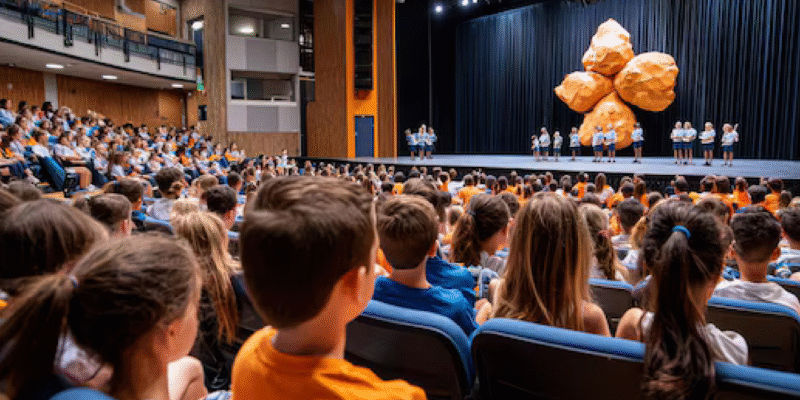
There’s a certain magic to sitting in a crowded school auditorium. You know the scene: parents shoulder-to-shoulder, phones ready, everyone waiting for their kid to step into the spotlight. The lights dim, the whispers stop, and suddenly the room shifts from ordinary to electric.
It’s a universal moment, and a surprisingly sharp mirror for leadership.
Because behind every recital, play, or school showcase is a quiet truth: growth is never the product of one performance. It’s the result of dozens of small, unglamorous reps that no one sees. And great leaders understand that their job is to create the environment where those reps turn into confidence, competence, and contribution.
That auditorium isn’t just a room full of families. It’s a lesson in holistic development.
Holistic Growth Happens When Every Voice Matters
At a school event, each kid plays a role, even if half the cast whispers their lines, one kid freezes like a deer in headlights, and another enthusiastically sings three beats ahead of the music.
But the point isn’t perfection.
The point is participation.
Leadership works the same way. Organizations with healthy cultures don’t expect everyone to deliver identical performances. Instead, they build systems where each person can contribute in a way that aligns with their strengths.
And when you zoom out, that diversity of talent is what creates a resilient, well-rounded team that can adapt, collaborate, and deliver consistently, even under pressure.
That’s holistic leadership: recognizing that greatness emerges from the collective, not the spotlight.
Patience Is a Leadership Advantage (Not a Luxury)
One thing every parent knows: skill doesn’t appear on cue.
Kids grow in unpredictable bursts.
Momentum builds invisibly.
Progress looks messy… until suddenly it doesn’t.
The same is true in business.
Teams need time to gel.
Creative ideas need space to breathe.
Strategy needs room to mature into results.
Leaders who understand this operate differently. They don’t force breakthroughs. They cultivate them. They create clarity, reduce friction, and protect the team from unnecessary noise.
Patience doesn’t slow an organization down.
It actually accelerates it because people do their best work when they’re not performing with a metaphorical stopwatch over their heads.
Consistency Is the Rehearsal Behind the Results
Every school event has one thing in common: dozens of rehearsals no one sees.
It’s the same with high-performing organizations.
What looks like a flawless campaign, a well-executed product launch, or a beautifully aligned brand is really the result of consistent systems, consistent expectations, and consistent leadership.
Consistency signals stability.
Stability builds trust.
Trust fuels performance.
Leadership isn’t found in the performance; it’s found in the practices that make the performance possible.
The Leader’s Role Is More “Supportive Parent” Than “Lead Actor”
In that packed auditorium, parents aren’t on stage. They’re in the audience, showing up, cheering on, steady and supportive.
That’s the leadership posture that elevates teams.
Great leaders:
• set the direction,
• build the environment,
• create psychological safety,
• celebrate progress,
• and let their people shine.
They understand that success is shared, stage time is earned, and the real win is watching others step confidently into their moment.
When you lead this way, the spotlight naturally finds the team — and the organization grows in ways that reflect depth, maturity, and long-term value.
When Leaders Get This Right, Everyone Rises
In the end, the auditorium metaphor holds true: people remember how it felt to be supported, trusted, and developed, and not necessarily how “perfect” the production was.
Great leadership isn’t loud, and it isn’t heroic. It doesn’t need a standing ovation.
It is quiet, stoic, proud, and grateful for the effort the team invested.
It’s simply intentional, patient, consistent guidance that empowers others to take the stage with confidence, again and again.
That’s how resilient teams grow.
That’s how organizations scale.
And that’s how leaders create impact that lasts well beyond the performance.